Roma 3-0 Sassuolo. The two impostors.

We, as Roma fans, know it all too well: defeat is part of the game. We know this especially well—we, the fifty-something Roma supporters who witnessed that invincible Roma side of the early 1980s. That team won the Coppa Italia in 1979–80 and 1980–81 (a season in which they also came agonizingly close to the *scudetto*, remembered for the infamous “Turone goal”), and then, in 1982–83—41 years after their first league title in 1941–42—they finally captured the Italian championship.

They seemed like an invincible team. Roma—especially at the Olimpico—would crush everyone in their path. This held true even during their 1983–84 European Cup campaign; they won every home match, often by a 3–0 scoreline, effectively securing their progression to the next round. That was until the final—that dreadful night in Rome at the start of the summer. May 30, 1984: Liverpool’s victory on penalties. Perhaps that night served as a "sliding doors" moment for this formidable Roma side—forever destined to be a team that aspired to greatness but could never quite grasp it.

A recurring theme in Greek tragedy is *hubris* (arrogance). A successful man may feel so powerful that he believes himself stronger than the gods. The gods then exact a terrible punishment upon him. One example is Icarus, the son of Daedalus; he flew too close to the sun, which burned his wings and caused him to fall to a disastrous end.
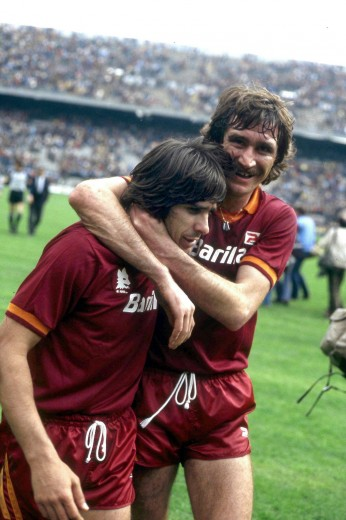
Yes, gentlemen, we felt omnipotent. This is the strongest team the world has ever seen—or so the *Commando* sang in the *Curva Sud*. We challenged the gods, and we were punished.

But that setback was actually a blessing for us. From a young age, we knew that 1) victory doesn’t arrive until the final whistle, even when you start as the heavy favorite; and 2) defeat is part of the game. Be wary of teams that never lose—just as it’s not right to never win.
An example of someone who exhibits unhealthy behavior regarding gambling is Trump, who feels omnipotent when he wins an election, yet dismisses the elections he loses as rigged.
We head into the break with 5 wins, 2 draws, and 2 defeats (both in the Champions League). The overall picture is objectively positive. We also controlled the match against Sassuolo just as we should have.
When I saw that Sassuolo was playing with a 3-5-2 formation—meaning only Cinquegrano was on the right flank—I realized that Hermoso was left unmarked (since Cinquegrano was being covered by Wesley) and that this could be the key to the match. The Spanish defender was able to move freely across the pitch, eventually finding himself in the penalty area to score the goal that put us in the lead.
| 11st Serie A | First Half | Second Half | Final Score | Scorers |
 | 27′ Hermoso, 30′ (OG) Walukiewicz, 58′ Mora | |||
 |
Sassuolo, managed by our old friend Alberto Aquilani, adopted a very defensive approach. This is not typically a characteristic of the Emilian black-green side, who usually play with a bold, attacking style. As a result, we dominated the match.
Then came Walukiewicz’s own goal (following a fine shot by Malen) and a brilliant goal from Rodrigo Mora. Both Rodrigo Mora and Matias Soulé are talented, yet they still have plenty of room for further development. Potentially, at least one of the two could go on to become one of the three best players in the world. Now, we shall see how they fare with Portugal and Argentina, respectively.
So: are we strong? Yes. Can we win the *scudetto*? Yes. Is it mandatory? No. We aren’t compelled to win it. If we don’t win it, it’s not a tragedy. There are teams that are stronger (like Inter) or luckier (like Lazio). Should we play to win? Yes, but without any mandates. Without pressure. With a light heart. Whatever will be, will be. We will follow you everywhere. We will support you everywhere. Whatever will be, will be.
Daje Roma!
Giordano Sepi